Long ago — before cars, before snowplows, before the light in your kitchen — winter came to Hampton and stayed.
Snow climbed the windows. The rivers turned to stone. And everybody waited, because winter was when the hard work got done.
A Hampton Story Since 1854
For more than 170 years, Corinthian Lodge No. 13 has been part of the story of Hampton, New Brunswick — through four addresses, one change of charter, and one winter crossing of a frozen river that Hampton has never stopped talking about.
A Hampton story, told for young readers — the winter the lodge went out onto the river, told one picture at a time. The full history, with dates and records, follows below.
Long ago — before cars, before snowplows, before the light in your kitchen — winter came to Hampton and stayed.
Snow climbed the windows. The rivers turned to stone. And everybody waited, because winter was when the hard work got done.
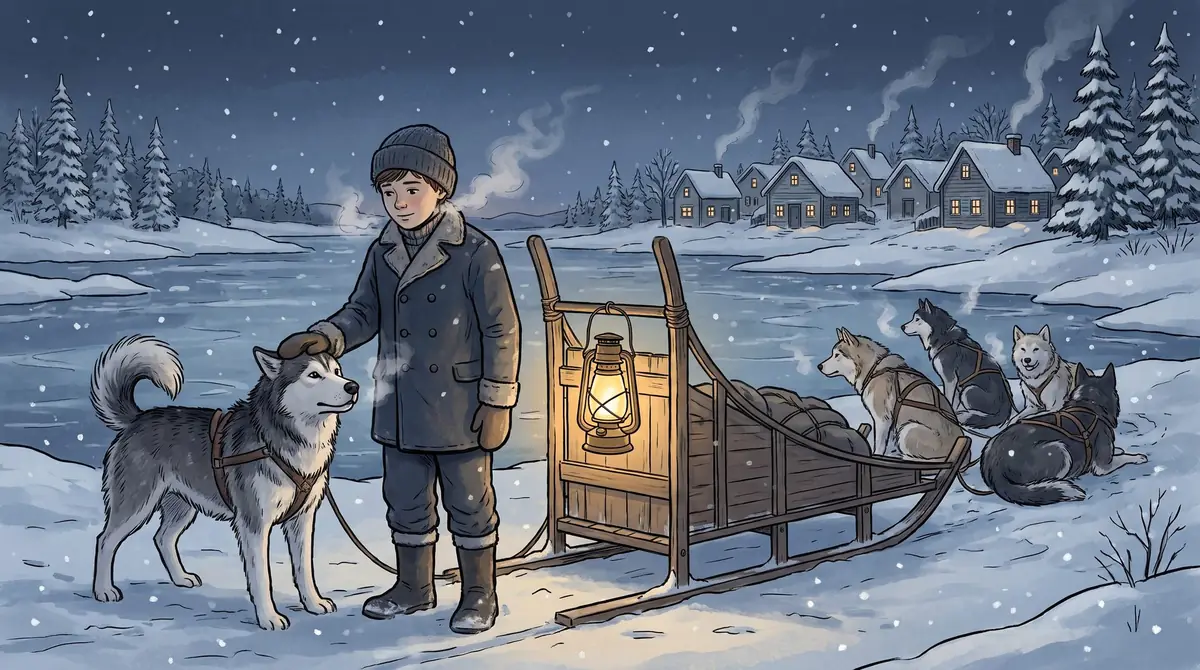
William was twelve. He had six dogs, one sled, and cold hands.
All winter he carried letters up and down the river — because in Hampton, the river was the road.
His lead dog was called Ruth. She could hear the ice thinking.
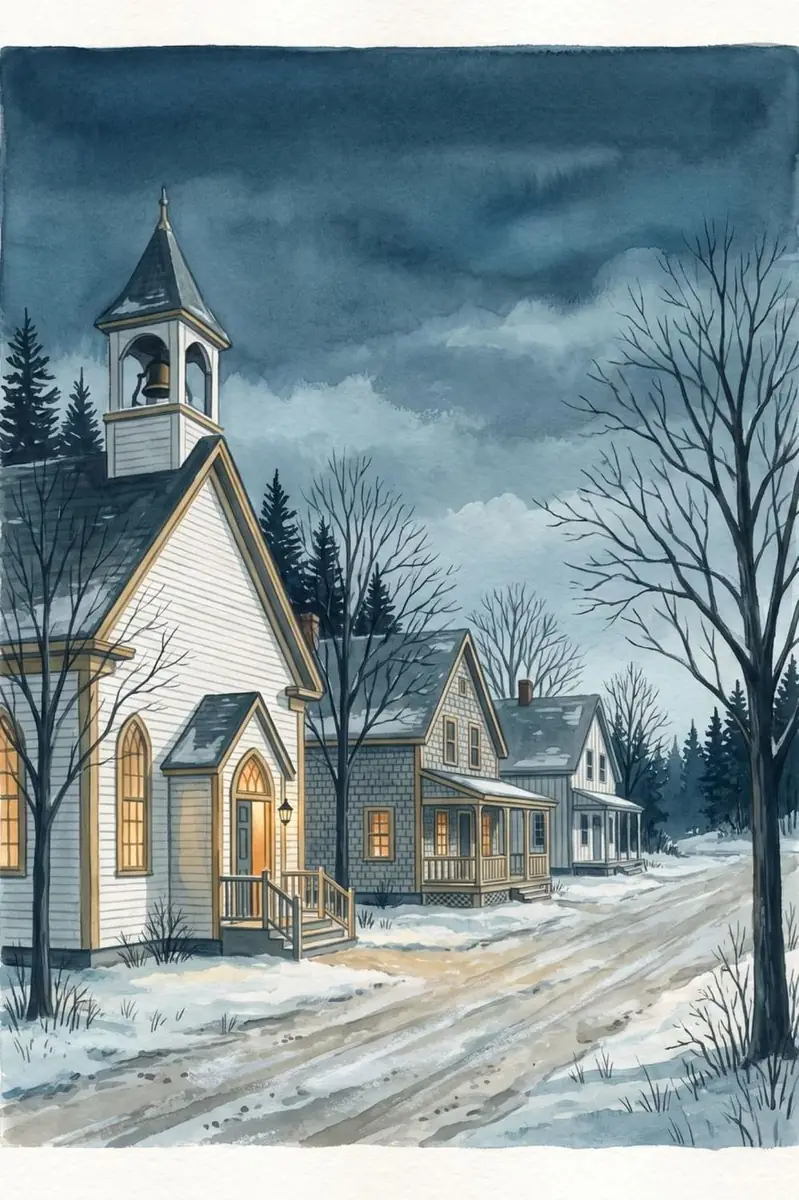
In the middle of town stood a hall. Not a grand one. Wood, and a stove, and a good solid floor.
The men of Corinthian Lodge No. 13 met there. So did everybody else — for suppers, and meetings, and music on a Saturday.
It was the building the town kept.
Then the railway came, and the shops moved to meet it, and the people moved to meet the shops.
The hall was in the wrong place now.
So somebody said the thing that started it all: “We'll just take it with us.”
But how do you move a building?
You cannot carry a hall. You cannot roll it up like a rug.
You can put it on skids — great wooden runners, like the biggest sled in the world. And then you do the strangest part.
You wait for the river to freeze.
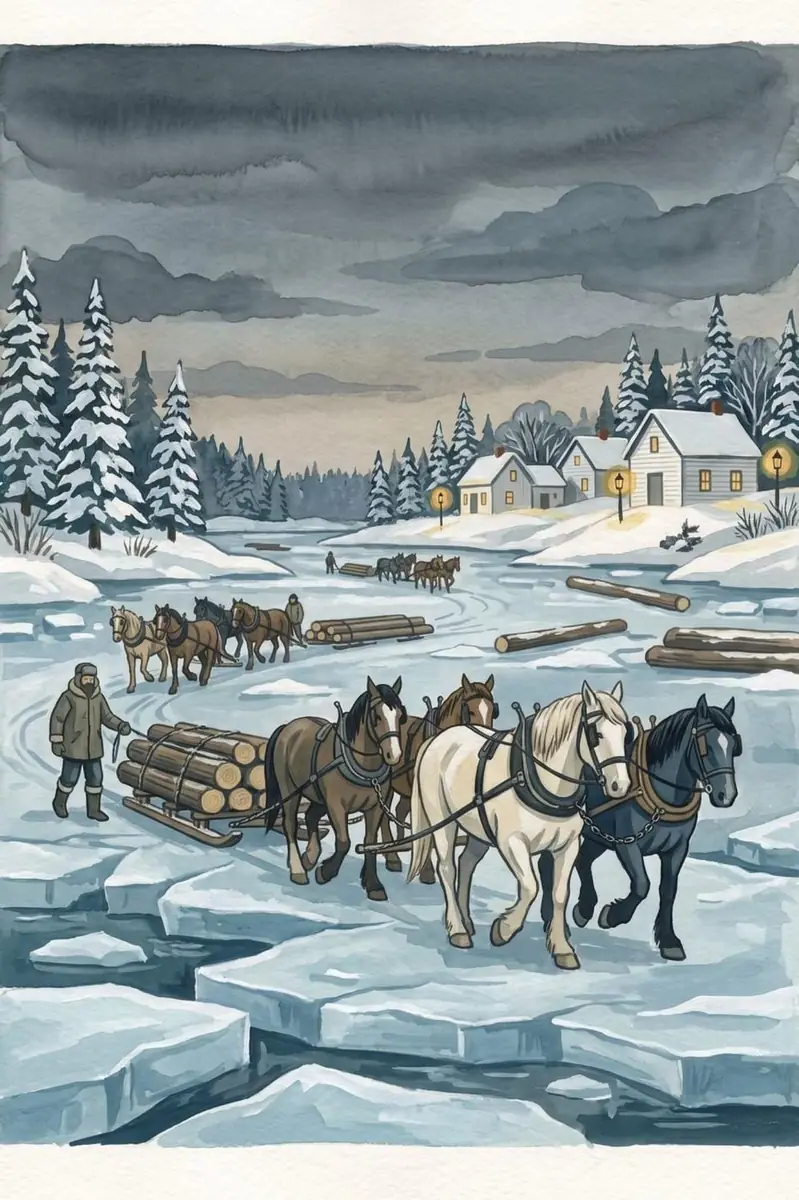
By January the ice was thick enough to hold a horse. By February, thick enough to hold a house.
Ice was not a danger to the people of Hampton. Ice was a gift. It was flat, and it was free, and it went where no road went.
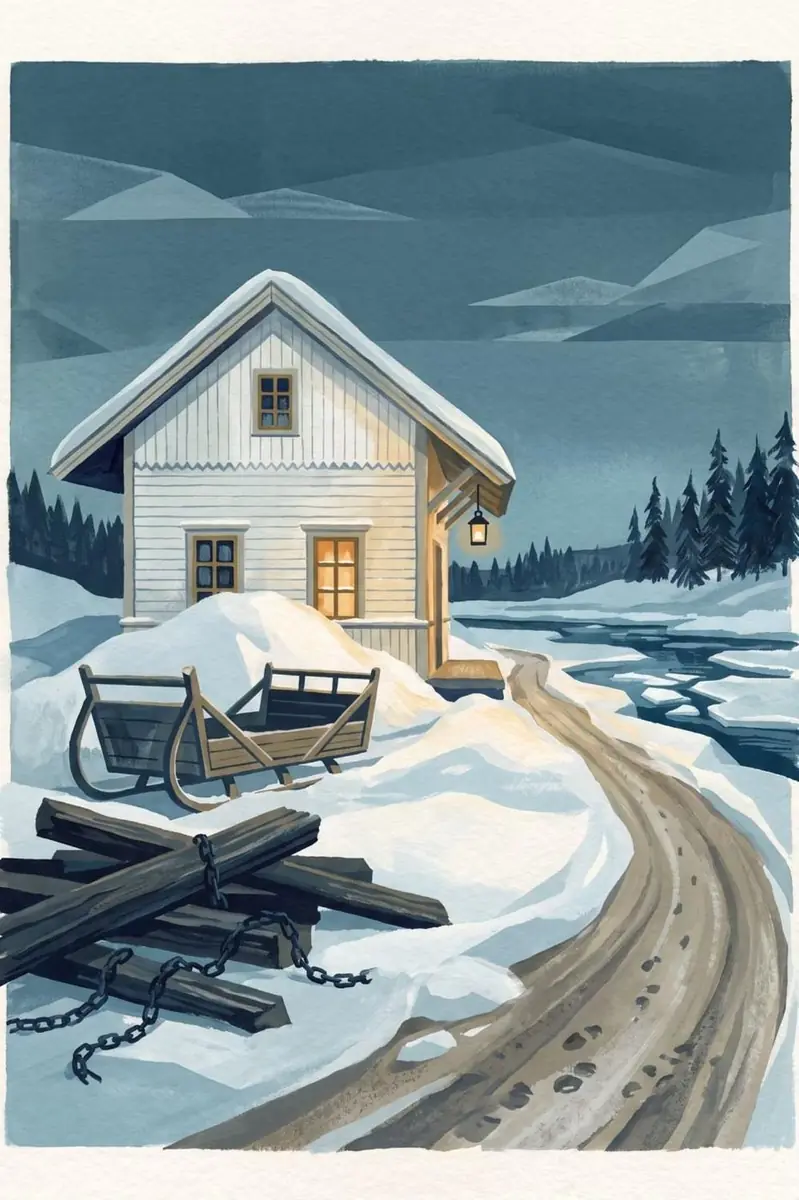
They sent William out first, because he was light and his dogs were lighter.
Ruth walked with her ears forward. William listened to the sound under his runners, the way his father had taught him.
A long, low hum means good ice. But a tick, or a whisper, or a sound like a door opening far away — that means turn around.
That morning, the ice hummed.
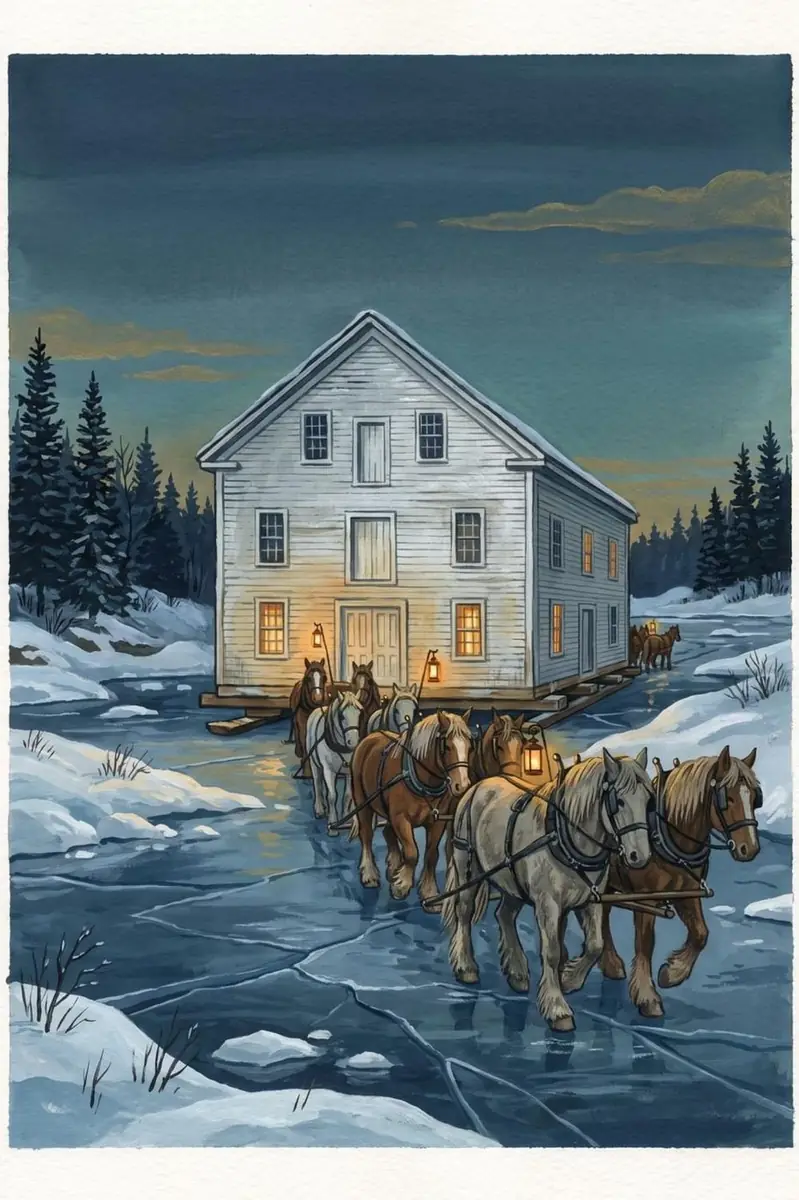
Then came the horses. Eight of them, and then eight more.
Steam rose off their backs. Their breath hung in the air like smoke. Chains rang. Men walked beside them with long poles.
And behind them all, sliding slow as a cloud — the hall.
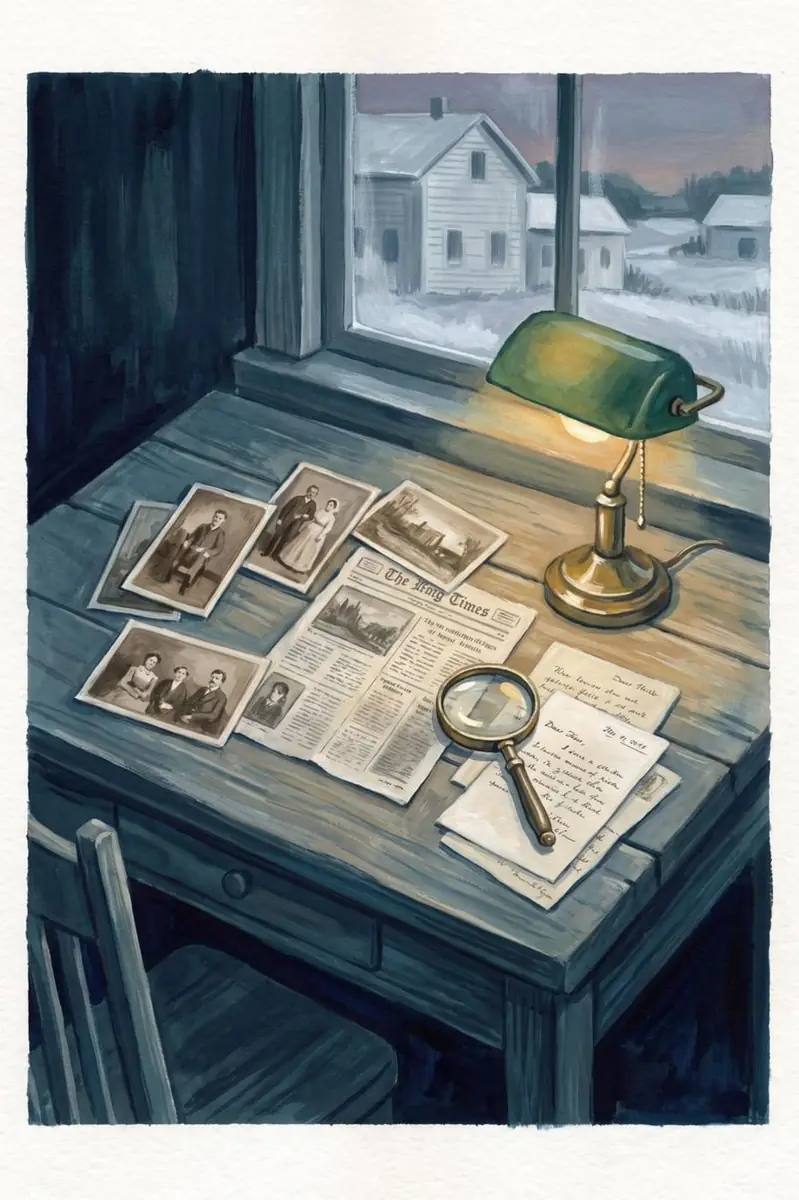
Nobody talked. You do not talk on the ice.
You listen — to the runners, to the chains, to the river underneath, still moving in the dark the way rivers always are.
Halfway across, the hall was further from shore than it had ever been from anything.
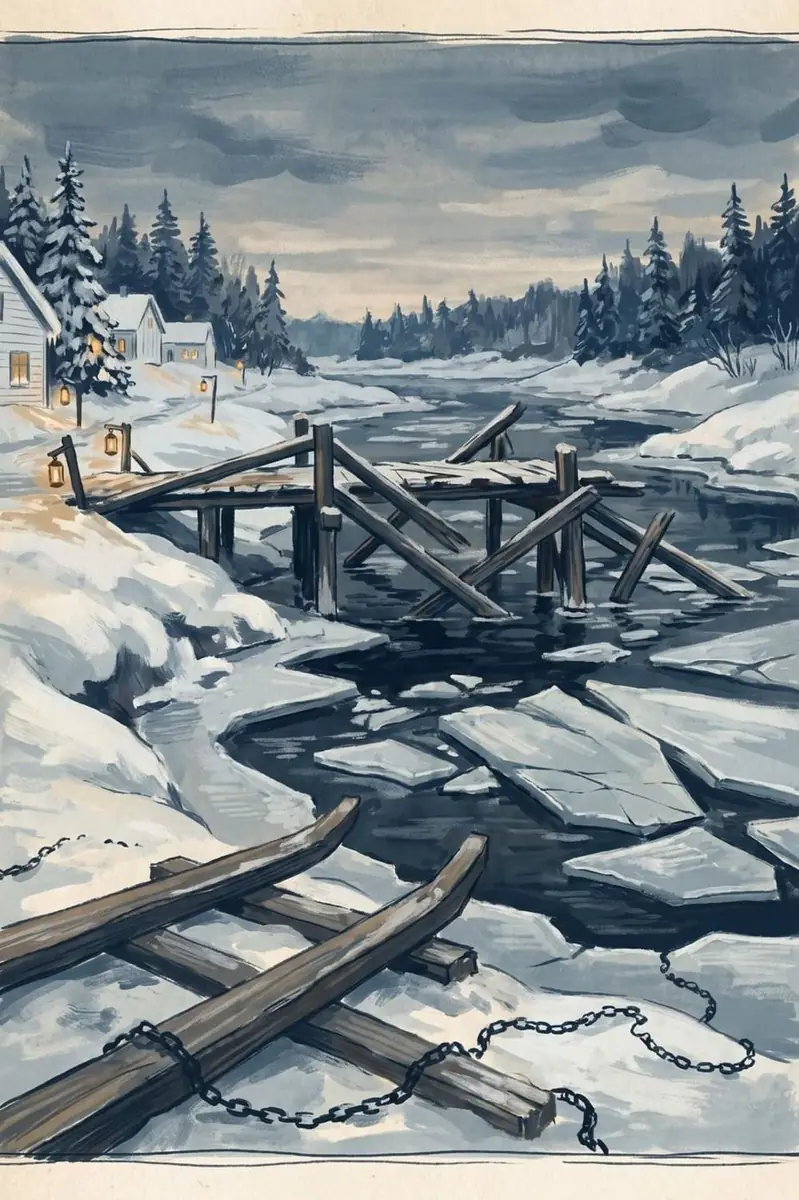
Then came the sound.
Not a bang. Worse than a bang. A long, splitting CRRRACK that ran out under the ice in every direction, like lightning going the wrong way.
The hall tipped. The ice opened. And down it went.
Men shouted. Horses screamed and scrambled for the far bank, and the men cut them loose so the chains would not take them down too.
William held Ruth by the collar and did not let go.
Black water came up through the break. The hall sat down into it.
And for one terrible minute, Hampton had no hall at all.
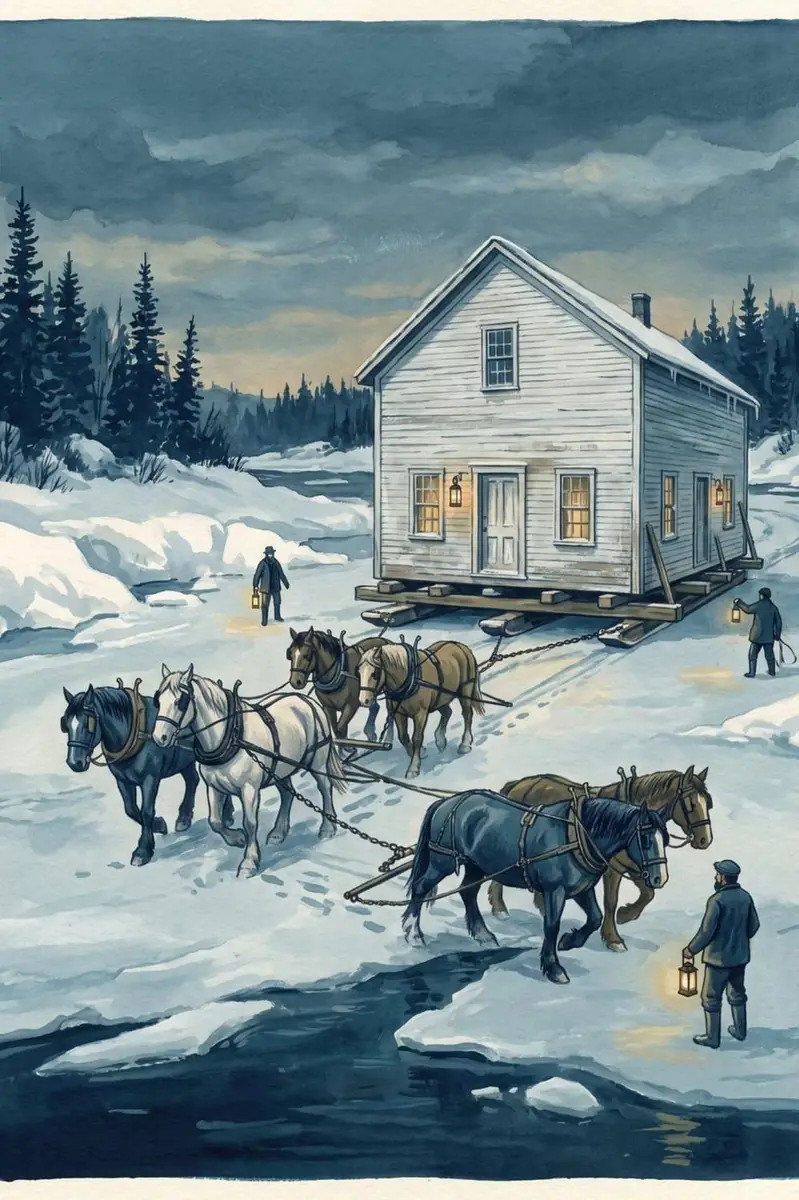
But they came back for it.
The next day, and the day after that. Ropes under the sills. Chains around the beams. Planks laid flat so the ice would hold.
Every horse in the parish leaning into the pull — and every man and boy in Hampton on the line behind them.
“Heave,” somebody called. And they heaved.
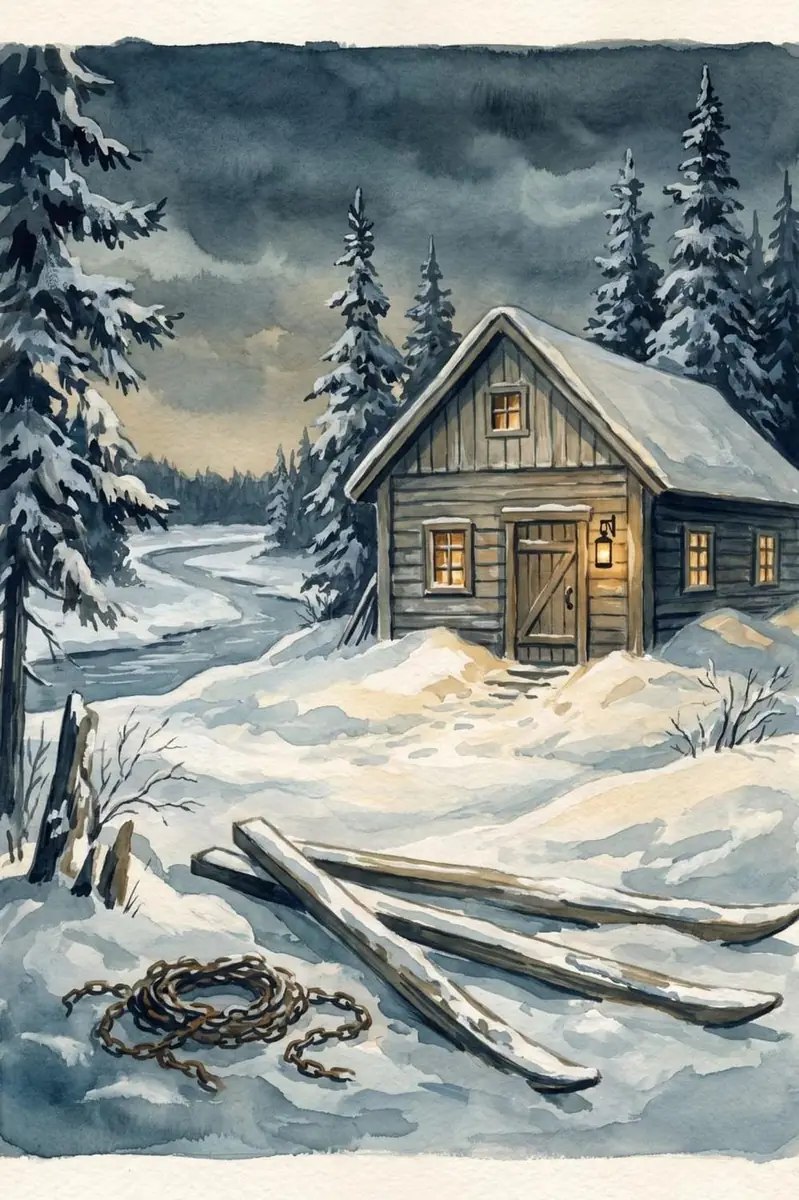
And the hall came up out of the river.
Wet through. Scarred along one side. Full of ice and river weed.
Still a hall.
They dried it out, and they set it down on the far side, and somebody lit the stove.
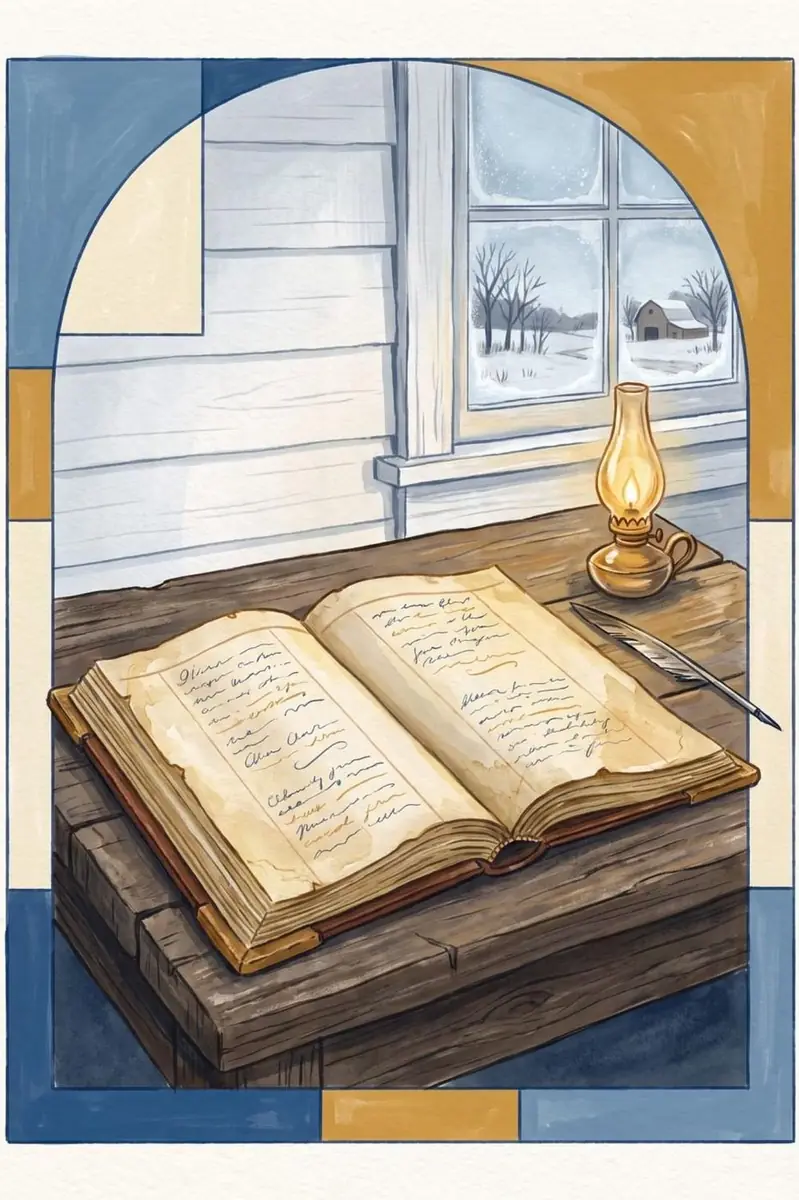
That hall stands on Church Street in Hampton today. You can walk past it. You can go inside.
The floor you would stand on has been at the bottom of a river.
And that is why, a hundred and seventy years later, we are still telling you about it.
Page 1 of 14.
Open any entry to read the fuller account, and follow the records where they lead.
10 of 10 entries shown.

Before there was a building, there was a request. In 1853 a group of Kings County men put their names to a sheet of paper and asked for a lodge of their own.

The lodge was constituted in 1854 under an English warrant, placing a chartered lodge in Kings County for the first time.

The lodge spent its earliest years at Norton — several miles from the village whose name it would come to carry.

In October 1857 the lodge left Norton for the village of Hampton. It has been a Hampton lodge ever since.

In November 1867, months after Confederation, the lodge gave up its English warrant and came under the Grand Lodge of New Brunswick.

In September 1872 the lodge changed quarters to Hampton Station, where the railway had pulled the centre of the community.

They waited for the river to freeze, put the lodge building out onto the ice, and started across. Halfway over, the ice gave way.

Corinthian Lodge No. 13 stands at 6 Church Street, Hampton, where the hall remains in regular community use.

The Provincial Archives of New Brunswick holds the Corinthian Lodge No. 13, F. & A.M. (Hampton) fonds, MC2275, spanning 1853 to 2016.

Much of Hampton's history lives in kitchens and photo albums. The next stretch of this page is being written by the community.
This is a living history. The lodge has been part of Hampton since 1854, and the story keeps growing as families open albums, attics and shoeboxes across Kings County. If you have something to add to it, the lodge would be glad of it.
An illustrated telling of the lodge’s first twenty years — the petition, the three moves, and the winter the lodge went out onto the river and did not make it all the way across.
Slide 1 of 11.
Everything in these slides also appears as text on this page, in the timeline above — the slides are a second way to read the same history, not the only way.
The lodge’s archival record is held publicly. The Provincial Archives of New Brunswick lists it as the Corinthian Lodge No. 13, F. & A.M. (Hampton) fonds, Fonds MC2275, covering 1853–2016. Anyone researching a Hampton family, a Kings County business, or the civic life of the parish can consult it.
Provincial Archives of New Brunswick(opens in a new tab)"4 Addresses. One River.
Over 170 Years Later And Our Doors Are Still Open"